The Day Bengal Was Divided: Curzon's Decision That Ignited a Nation
Explore the 1905 Partition of Bengal, announced by Lord Curzon on July 20, and its profound impact on Indian nationalism and the independence movement.
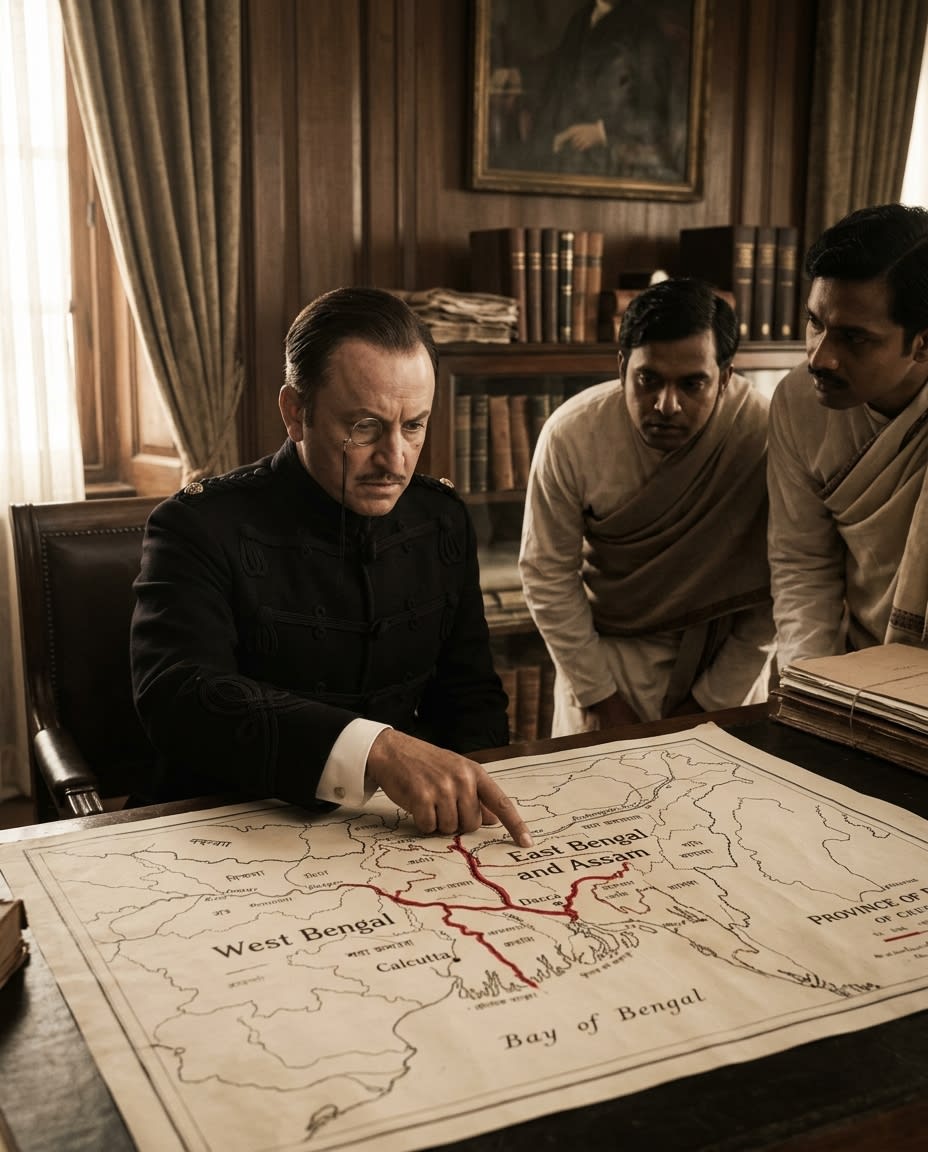
The vast province of Bengal, encompassing present-day West Bengal, Bangladesh, Bihar, Odisha, and parts of Assam, was a cornerstone of British India at the turn of the 20th century. Its sheer size and diverse population, however, presented significant administrative challenges for the colonial government. More importantly, Bengal was the intellectual and political heartland of nascent Indian nationalism, a hotbed of awakening political consciousness and growing dissent against British rule. The city of Calcutta (now Kolkata) served as the capital of British India, a vibrant hub where ideas of self-governance and independence were taking root.
Lord George Curzon, the Viceroy of India from 1899 to 1905, was a staunch imperialist who believed in the efficiency and permanence of British rule. He viewed the administrative unwieldiness of Bengal as a primary impediment to effective governance. His proposed solution was a radical one: to partition the province into two separate entities. The official rationale was purely administrative – to create smaller, more manageable provinces for better governance and development. However, many Indians, particularly Bengali nationalists, saw through this veneer. They suspected a more sinister motive: to weaken the burgeoning nationalist movement by dividing the politically conscious Bengali-speaking population along religious lines.
On 20 July 1905, Lord Curzon formally announced the partition of Bengal. The plan proposed dividing Bengal into a predominantly Hindu western part (Bengal, Bihar, and Orissa) and a predominantly Muslim eastern part (Eastern Bengal and Assam). This announcement sent shockwaves across the province and the entire subcontinent. Indian leaders and the general public immediately perceived it as a deliberate attempt to 'divide and rule,' to fragment the unity of the Bengali people and, by extension, the broader Indian nationalist sentiment. The decision was seen as an affront to Bengali identity and a direct challenge to the growing demand for greater Indian participation in governance.
The immediate aftermath of the announcement was a groundswell of unprecedented protest and outrage. The partition sparked widespread agitation, marking a significant turning point in India's freedom struggle. The 'Swadeshi' (self-reliance) and 'Boycott' movements gained immense momentum, urging Indians to boycott British goods and institutions, and instead promote indigenous industries and education. Public meetings, processions, and demonstrations became commonplace, transcending religious and social divides as people united against the common colonial adversary. Leaders like Surendranath Banerjee, Bipin Chandra Pal, and later, Rabindranath Tagore, played crucial roles in galvanizing public opinion and channeling the widespread discontent into organized resistance.
The Partition of Bengal, though initially implemented, proved to be a monumental miscalculation by the British. Far from weakening the nationalist movement, it inadvertently strengthened it, forging a stronger sense of unity and resolve among Indians. The protests were so intense and sustained that the British government was eventually forced to reconsider its decision. In 1911, King George V announced the annulment of the partition during his visit to India, a major victory for the Indian nationalist movement. However, the administrative restructuring continued, with the capital of British India being shifted from Calcutta to Delhi, and new provinces like Bihar and Orissa being carved out.
The legacy of the 1905 Partition of Bengal extends far beyond its annulment. It demonstrated the power of mass mobilization and non-violent resistance, inspiring future generations of freedom fighters. It also highlighted the British policy of communal division, which would tragically culminate in the partition of India in 1947. The event served as a crucible for Indian nationalism, pushing it beyond the confines of intellectual debate into a mass movement. It underscored the importance of unity in the face of colonial tactics and remains a powerful reminder of how a seemingly administrative decision can ignite the flames of national identity and resistance.

The Nation's Farewell: Bal Gangadhar Tilak's Ashes Immersed

Napoleon's Eastern Gambit: How a French Alliance Sealed Tipu Sultan's Fate
